
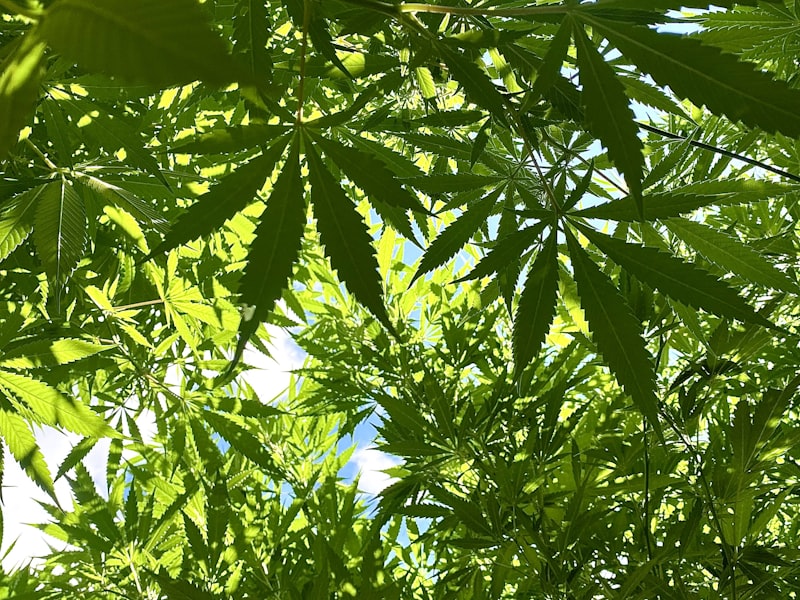
The number on the front of a cannabis label is almost always THC. It is the figure dispensary staff mention first, the one printed largest on most packaging, the unit by which products are marketed and compared. THC content drives the conversation because it is the compound that produces intoxication, and for a long time intoxication was the primary value proposition of cannabis products. A tincture formulated with 900 milligrams of CBD and 30 milligrams of THC makes a different argument: that the compound present in the smaller quantity shapes the experience as much as the one present in larger. Understanding why requires looking at what each number actually does.
The per-dose math
Thirty milligrams of THC in a 30-milliliter bottle works out to 1 milligram of THC per milliliter. At a standard 1mL dose, you are taking 30mg CBD and 1mg THC. One milligram of THC is below the threshold for any noticeable psychoactive effect for essentially everyone — clinical studies on THC generally find the lowest dose that produces measurable subjective effects sits around 2.5 milligrams, and many people do not register anything below 5mg. At 1mg, the THC in this formula is not producing intoxication. It is not the primary driver of sleep onset or relaxation. The question worth asking is: why include it at all? If the goal is CBD's effects, why not simply use a CBD-only product?
The answer has to do with how CBD works — and with what it cannot do without help.
What sub-threshold THC adds
CBD does not bind directly to CB1 receptors, the primary targets for THC in the endocannabinoid system. Instead, CBD works through a cluster of indirect mechanisms: it modulates CB1 receptors through allosteric pathways (changing receptor behavior without directly activating it), interacts with serotonin 5-HT1A receptors involved in anxiety and mood, and affects the reuptake of endogenous cannabinoids. These are all real and meaningful actions, but they leave one pathway largely untouched: direct CB1 activation, which regulates pain, anxiety, mood, and sleep signaling through mechanisms CBD alone cannot fully access.
Sub-threshold THC — amounts too small to produce intoxication — may activate CB1 signaling in ways that amplify what CBD is doing through its other mechanisms. This is not the standard entourage effect argument, which is usually about CBD reducing a high-THC experience. It is the quieter version: trace THC priming a pathway that CBD bypasses, and that priming changing the overall response. The clinical evidence for this specific mechanism at 1mg doses is limited, mostly inferred from the broader CBD-THC interaction literature rather than from 30:1-specific research. But the underlying biology is plausible, and the practical observation — that many people find low-dose THC alongside CBD more useful than CBD alone at equivalent doses — is consistent with it.
The CBD dose matters independently
The 900 milligrams of CBD per bottle also matters for reasons entirely separate from the ratio. At 30mg of CBD per 1mL serving, this is a dose in the range used in clinical research on CBD. Studies demonstrating measurable CBD effects on anxiety, sleep, and inflammation typically use doses in the 25 to 150mg range per day. Many commercially available CBD products deliver considerably less than this: a 300mg bottle at 1mL per serving contains only 10mg per dose, which falls below the range in most positive CBD trials. At 30mg per serving, each dose of a 900mg formula sits in the range where CBD is actually likely to do something — rather than in the lower range where effects remain uncertain.
This is a distinction worth making explicitly, because the CBD marketplace contains an enormous range of products whose labels look similar but whose per-dose amounts differ by a factor of three or four. Total bottle milligrams are not the relevant number. Per-dose milligrams are.
Why CBD does not simply scale upward
The dose-response curve for CBD is not as straightforward as most labels imply. CBD works through multiple mechanisms simultaneously, and those mechanisms do not all behave the same way as dose increases. For anxiety, some research suggests a bell-curve response: moderate doses produce the most reliable anxiolytic effect, with diminishing returns and, for some people, a plateau or slight reversal at very high doses. For epilepsy, where CBD's clinical evidence is strongest, the dose relationship is more linear. For sleep, the picture is not yet fully clear.
What this means practically is that more CBD is not always more effective, and that hitting the right range — rather than maximizing the amount — is the actual goal. The 30mg per dose that a 900mg formula delivers is a reasonable target for that range. The trace THC may help stabilize the response by activating the CB1 pathway that CBD cannot reach directly, producing a more complete endocannabinoid system engagement at a dose that is still fully non-intoxicating.
Who this formula is for
The 30:1 ratio is not designed for people who want a noticeable cannabis experience. The THC is too low and the CBD too dominant for that. It is for a different use case: people who want the effects of a meaningful CBD dose with the THC kept below the intoxication threshold. That includes people who have had adverse high-THC experiences in the past. People who want a daytime formula formulated to stay sub-perceptible. People who are early in their experience with cannabis and want to start at the low end of the range. And people who have been using CBD-only products and found them underwhelming at lower doses, and want to explore whether trace THC changes the equation.
The ratio as a formulation philosophy
The 30:1 ratio represents a specific position: CBD does the work, and THC serves a supporting role that is real but deliberately kept sub-perceptible. It is different from a 10:1 ratio, where THC is more present and may produce mild perceptible effects at a standard dose for some users. It is different from a 1:1, where CBD and THC are equals and intoxication is a feature, not a side effect to manage. And it is different from a CBD isolate, where the trace THC activation mechanism is absent entirely.
For more on the broader biology behind why cannabinoid ratios matter in this way, the entourage effect piece covers the research in depth. And for the formula built around this principle, Big Sky Calm is the 30:1 product — 900mg CBD, 30mg THC, formulated with the THC deliberately kept sub-perceptible.
The StarFlora Journal is published by StarFlora, which makes and sells the cannabis tinctures linked in these articles. Articles are general information about cannabinoids and formulation — they are not medical advice, and they are not a substitute for talking to a healthcare provider. Individual responses to cannabinoids vary.